The Two-Second Window
What Actually Happens When You Wait Two Hours to Respond

Go on this journey with me….Someone fills out your contact form at 2:47 PM.
Their buying intent is at absolute peak. They just spent 20 minutes on your site. Read three case studies. Watched your demo video. They’re ready.
What happens next determines everything.
The 2-Second Response: Peak Intent Captured
2:47:02 PM - Your system responds
The lead gets an immediate reply. Not a generic autoresponder. A contextually aware message that references what they looked at, acknowledges their specific situation, and offers the next clear step.
Their brain registers: These people are paying attention. They’re organized. They care about my time.
The emotional state stays hot. The prefrontal cortex hasn’t kicked in yet to second-guess the decision. They’re still in the same mental space that made them hit submit in the first place.
The data backs this up.
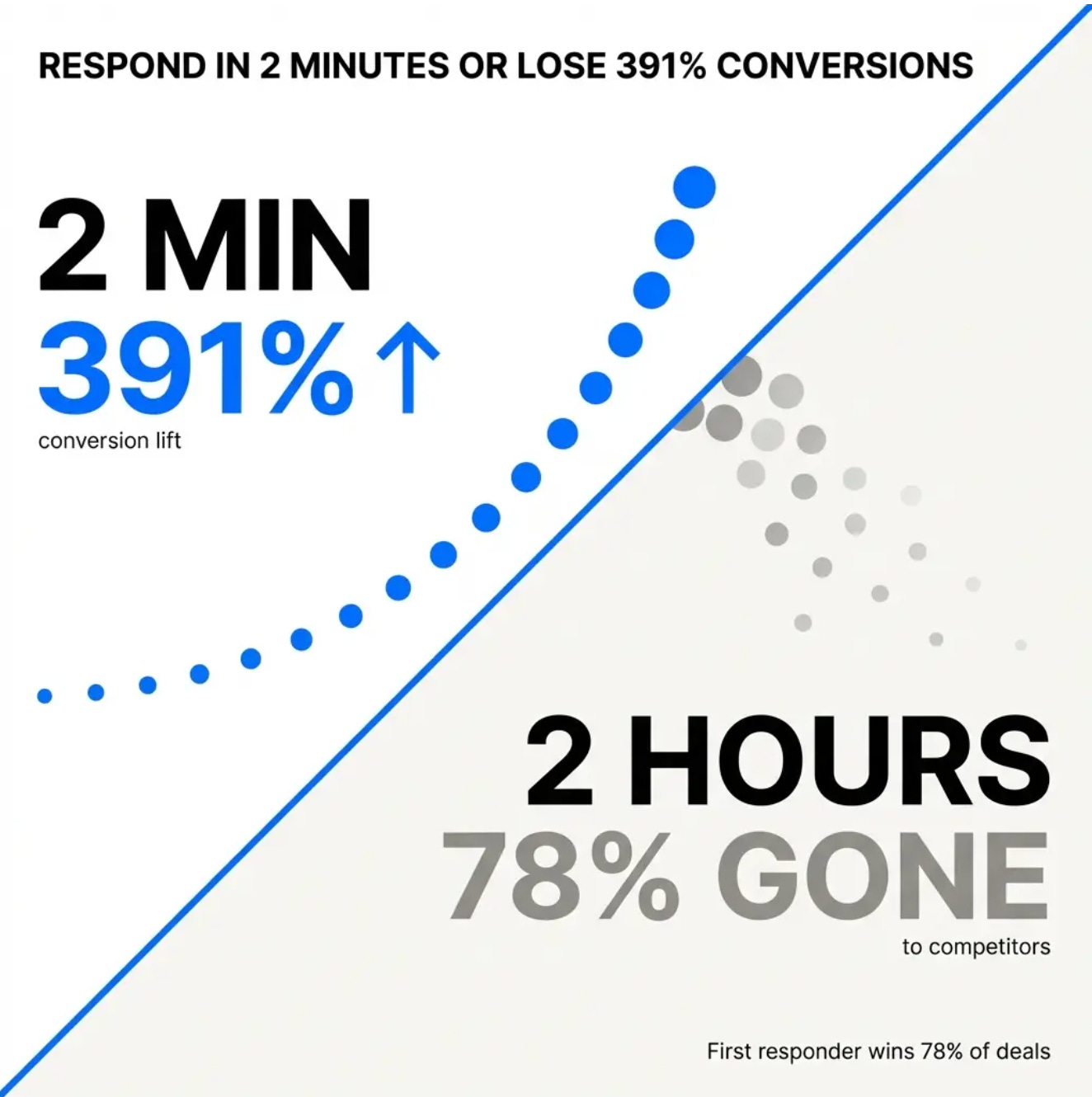
Responding within the first minute can boost lead conversions by 391%. Wait just one more minute for a two-minute response time and that conversion lift drops by more than half.
You’re 100 times more likely to connect with a lead in the first five minutes versus waiting just 30 minutes. Not 10% more likely. Not twice as likely. One hundred times.
The 2-Hour Response: Intent Already Gone
4:47 PM - You finally reply
Two hours have passed. Here’s what happened in that window:
The lead filled out two more contact forms. Your competitors responded in 8 minutes and 14 minutes respectively. One of them already had a 15-minute discovery call scheduled.
The emotional urgency that drove the initial action has completely evaporated. The limbic system handed control back to the prefrontal cortex. Now they’re in evaluation mode, not decision mode.
They’re comparing options. Reading reviews. Talking themselves out of the investment. The moment is gone.
The psychology is brutal.
The human brain processes emotional stimuli 3,000 times faster than rational thought. 95% of purchasing decisions are subconscious, driven by emotional responses rather than rational analysis.
When someone submits a form, they’re operating from emotion. Wait two hours and you’re asking them to make the same decision from a completely different mental state.
It doesn’t work.
The Competitive Reality Nobody Talks About
Here’s the part that should keep you up at night.
78% of customers buy from the first company that responds to their inquiry.
Not the best company. Not the cheapest. Not the one with the most impressive credentials.
The first one.
A Harvard Business Review study analyzed 2.24 million sales leads. Firms who contacted potential customers within an hour of receiving a query were nearly seven times as likely to qualify the lead as those who waited even 60 minutes.
Your competitors know this. Some of them are already responding in minutes. Every hour you wait is an hour they’re capturing leads at peak intent while you’re still checking your email.
The Industry Standard Is Broken
The average B2B lead response time is 42 hours.
Let that sink in. Nearly two full days.
A 2024 study by RevenueHero looked at over 1,000 companies. The results were worse than expected:
• Over 63% didn’t respond at all
• 20% responded within an hour
• Only 17% responded instantly
• Average response time: 29 hours
This creates an opportunity. When the standard is broken, fixing it becomes your competitive advantage.
The Decay Pattern: How Fast Intent Dies
Intent doesn’t fade gradually. It falls off a cliff.
Under 5 minutes: Maximum conversion potential. The lead is still in the same emotional state that drove them to reach out.
5-10 minutes: 10x decrease in qualification likelihood. The moment is starting to pass.
10-30 minutes: 21x decrease in qualification likelihood. They’re already looking at other options.
After 1 hour: The lead is likely already talking to a competitor. Your window is closed.
Calling a lead within the first minute boosts conversion rates by 391%. Wait one more minute and conversion rates drop to 120%. Wait an hour and they drop to 36%.
The cliff is real. The data proves it.
What This Actually Means for Your Business
Let’s do the math.
MIT research shows businesses lose a minimum of $90,000 annually at a 2,000-lead volume with slow response times. That’s the baseline.
If you’re running an agency or coaching business doing $500K to $2M annually, your lead volume is probably higher. Your average deal size might be bigger. The actual loss compounds fast.
Every lead you lose to slow response is a lead your competitor captures. They’re not just winning the deal. They’re building the relationship, getting the testimonial, earning the referral, and compounding their authority while you’re still trying to figure out why your conversion rates are stuck.
The System Problem, Not a People Problem
You can’t manually respond in two seconds. You’re in meetings. You’re doing client work. You’re building the actual business.
Telling someone to “just check email more often” is not a solution. It’s a recipe for burnout and a guarantee that you become the bottleneck for everything.
The businesses winning this game built systems that respond instantly without requiring human intervention at the first touch point. The AI handles the immediate response. The human steps in when judgment matters.
That’s the boundary where value concentrates.
Why the Response Authority Alignment System Works
Generic autoresponders don’t solve this. They trigger the instant response, but they kill trust just as fast.
“Thanks for your interest. Someone will get back to you within 24 hours.”
That’s not a response. That’s a delay notification.
The Response Authority Alignment System captures leads at peak intent because it responds in seconds with context. It knows what page they visited. It understands what problem they’re trying to solve. It speaks in your voice, references your frameworks, and moves them to the next step without feeling robotic.
The lead gets the speed they need and the relevance they expect. You get the conversion without becoming a slave to your inbox.
The system runs in the background. You show up when it matters. The gap between expertise and execution collapses entirely.
The Real Cost of Waiting
82% of consumers want a business to reply within 10 minutes of reaching out. When that doesn’t happen, frustration sets in.
Slow response doesn’t just cost you the deal. It damages your brand before the relationship even starts.
The lead assumes you’re disorganized. They question whether you’ll be responsive after they become a client. They wonder if this is what working with you will feel like.
You never get a second chance to make a first impression. In the digital world, that first impression happens in the first two minutes or it doesn’t happen at all.
What Happens Next
You have two paths forward.
Keep doing what you’re doing. Check email when you can. Respond when you have time. Watch 78% of your leads go to whoever responds first. Accept that your conversion rates will stay stuck because the system is broken.
Or build infrastructure that captures leads at peak intent. Install a system that responds in seconds with context. Let AI handle the repetition while you handle the inflection points.
The businesses that win in the next five years won’t be the ones with the best marketing. They’ll be the ones with the best systems.
Speed compounds. Delay bleeds.
And right now, you’re sitting exactly where your leads sit every day — at peak intent, deciding whether to take the next step or close the tab.
So instead of telling you how the Response Authority Alignment System works, let me show you.
We built a live demo you can try right now. No waiting 42 hours for someone to get back to you. Just a real-time conversation with an AI system that responds the way your business should — instantly, with context, in a voice that actually sounds like it gives a damn.
Two minutes on the other side of this link and you’ll understand exactly what your leads experience when speed meets alignment and automation.
👉 Try the Response Authority Alignment System Demo
Your move.